What otoplasty actually changes.
The visible change after otoplasty is in the auriculocephalic angle — the angle between the ear and the side of the head. We aim to restore this from a prominent 30–45° to a natural 17–21°.
We use schematic illustrations rather than real patient photos to protect patient privacy and to avoid restrictions on medical advertising under Turkish Ministry of Health regulations. In-person and video consultations include selected anonymized patient photos relevant to your specific anatomy.
The fundamental change
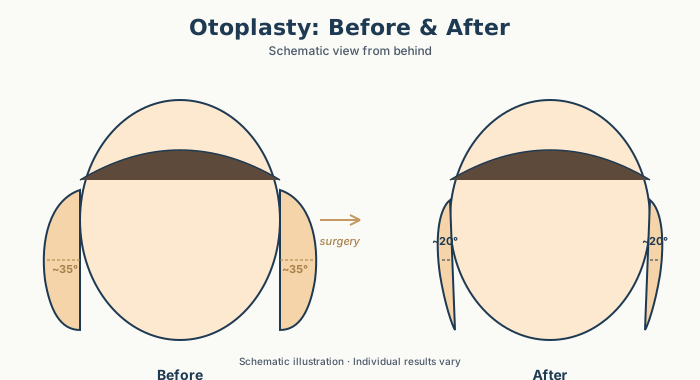
The schematic above shows the basic geometry of the operation. Before surgery, the ears protrude at approximately 30–45° from the head — visible from the front, casting a noticeable silhouette. After otoplasty, the angle is reduced to a natural 17–21°. The ears are visible from the front (as they should be) but no longer dominate the silhouette.
What we aim for
Natural, not pinned
The single most important principle of modern otoplasty is to avoid over-correction. An "over-pinned" ear — one pulled too far back, with the helix touching the side of the head — looks artificial and unnatural. The McDowell criteria (1968) for an ideal otoplasty result are:
- All protruding parts of the helix should be visible beyond the antihelix when viewed from behind
- The helix should have a smooth, regular curve without sharp angles
- The ear-to-skull distance at the top should be 10–12 mm
- The ear-to-skull distance in the middle should be 16–18 mm
- The ear-to-skull distance at the bottom should be 20–22 mm
- The ears should be symmetric to within 3 mm at any level
- The postauricular sulcus (crease behind the ear) should not be distorted
These remain the gold-standard criteria for evaluating otoplasty results today.
The natural antihelical fold
Beyond simple "setback," a well-done otoplasty creates a smooth, naturally curving antihelical fold — the inner Y-ridge that gives the ear its definition. Older techniques sometimes produced a sharp, ridged antihelix that looked obviously surgical. The cartilage-sparing technique used today produces a softer, more natural curve.
Different starting points
Not every prominent ear is the same, and the visible "before/after" change depends on what was wrong to begin with.
Type 1: Absent antihelical fold
The most common pattern. Upper third of the ear flops outward, conchal bowl is normal. The before/after change is most visible from the front and at the top of the ear.
Technique: Mustardé sutures
Type 2: Over-projected concha
The ear sits too far from the head as a whole. The antihelical fold may be normal. The before/after change is visible in profile view, with the whole ear moving closer to the skull.
Technique: Furnas sutures
Type 3: Combined deformity
Both antihelical fold absent and concha over-projected. About 30% of cases. The most dramatic before/after change because two corrections are being made simultaneously.
Technique: Mustardé + Furnas
Type 4: Prominent earlobe
The lobule sticks out even after the rest of the ear is corrected. Requires a separate lobule reduction or repositioning technique.
Technique: Lobule fixation suture or partial excision
What "natural" looks like
A successfully operated ear has these characteristics:
- The auriculocephalic angle is 17–21° — visible but not protruding
- The antihelical fold curves smoothly from the upper third through the middle, without sharp ridges
- The helix is fully visible from behind (it has not been pulled flat against the head)
- The lobule is in its natural position, neither pinned nor visibly sutured
- The contralateral ear (the unoperated side, if only one was done) and operated ear look symmetric to within 3 mm
If a patient came up to you and you didn't know they'd had surgery, you wouldn't notice anything except that their ears look proportionate to their head. That's the goal.
Timing of the visible result
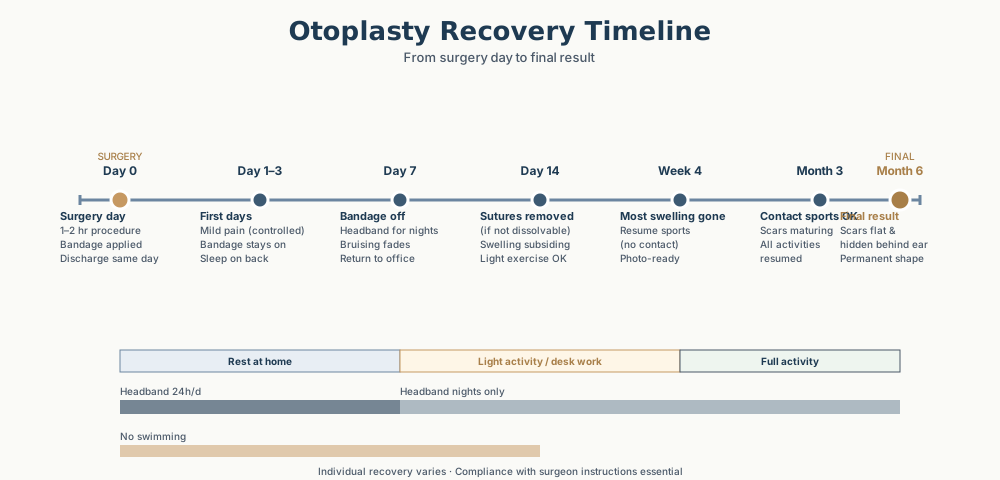
The visible result evolves over months:
- Day 7 — bandage off; ears look swollen and possibly bruised, but the basic new shape is visible
- Week 4 — most swelling resolved; ears look approximately as they will
- Month 3 — fine swelling resolved; scars beginning to fade
- Month 6 — final result; scars flat and barely visible
It's important not to judge the result before about month 3. Swelling can make ears look slightly larger or more prominent than they actually are during the first weeks.