Furnas Technique
Key facts
- Year described1968
- OriginatorD.W. Furnas
- Suture count3 per ear
- Anchor pointMastoid periosteum
- Cartilage traumaNone
- AddressesOver-projected concha
- Combined withMustardé (when antihelix absent)
- Setback amount4–8 mm typical
Why Furnas sutures matter
The Mustardé technique recreates the antihelical fold but does little to change the overall projection of the ear if the conchal bowl itself is over-projected. About 30% of prominent-ear patients have this 'conchal type' of prominence — the ear as a whole sits too far from the skull, even with a normal antihelix. For these patients, Mustardé alone cannot solve the problem.
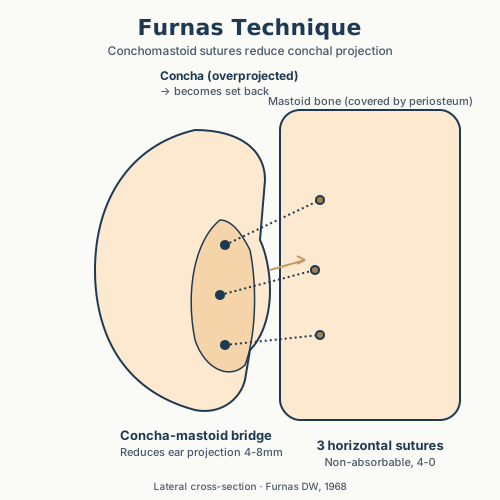
David Furnas's 1968 contribution was to recognize this anatomy and propose a specific solution: anchor the back of the concha to the mastoid bone behind it. As the suture is tightened, the entire ear is pulled toward the head.
Anatomy: why this works
The conchal bowl is a deep cartilage cup at the base of the ear. Behind it, separated only by a thin layer of soft tissue, lies the mastoid bone — part of the skull. The mastoid is covered by a tough fibrous periosteum that holds sutures securely.
By passing a suture through the back of the conchal cartilage and anchoring it to the mastoid periosteum, the surgeon creates a permanent attachment that brings the concha and the mastoid into closer contact. The ear, hinged on this new attachment, sits closer to the head.
Step-by-step: how Furnas sutures are placed
Exposure
Through the same posterior incision used for Mustardé sutures, the surgeon dissects further toward the conchal area. The thin tissue between the back of the concha and the mastoid bone is identified. Care is taken to identify and protect the great auricular nerve, which runs through this area.
Suture placement
Three sutures are typically used: upper, middle, and lower along the height of the conchal bowl. Each suture passes through the cartilage of the concha (taking a substantial bite to avoid cheese-wiring), then through the mastoid periosteum at the matching level.
Tying
Each suture is tied with the ear in its desired new position. The amount of setback is controlled by where on the mastoid the suture is anchored — closer to the cartilage gives less setback, further posterior gives more. The surgeon views the ear from above and from in front while tying, ensuring the angle is natural and symmetric to the other side.
External ear canal check
Excessive Furnas suturing can narrow the external auditory canal — an important complication to avoid. The surgeon always checks ear canal patency after each suture is tied. If narrowing is observed, the suture is loosened or repositioned.
Setback amount: how much is right?
Most patients need 4–8 mm of conchal setback. This sounds small, but at the helical rim (the outermost edge of the ear), it translates to a 10–15 mm reduction in projection from the side of the head. This is the difference between a noticeably prominent ear and a natural one.
Over-correction is the main risk: an ear pulled too far back appears 'pinned' or 'stuck to the head,' and the helix can lose its natural visible silhouette. We err on the side of less setback rather than more, knowing that minor under-correction is far easier to live with than over-correction.
Combining Furnas with Mustardé
When both antihelical fold absence and conchal projection contribute to prominence (about 30% of cases), the two techniques are combined. The Mustardé sutures are typically placed first to establish the new antihelical fold, then Furnas sutures are added to reduce overall projection.
The interaction between the two techniques is important. If the Mustardé sutures alone produce sufficient overall setback (by virtue of the new antihelical fold pulling the upper ear inward), Furnas sutures may not be needed. If after Mustardé placement the ear still projects, Furnas sutures are added.
Potential complications specific to Furnas
External ear canal narrowing
If Furnas sutures pull the concha medially without enough posterior vector, the external ear canal can be narrowed or angulated. This is uncomfortable and can affect hearing. It's avoided by careful suture vector planning and intraoperative canal checks.
Telephone deformity
If Furnas setback is excessive compared to the Mustardé correction, the middle of the ear can be pulled too far back relative to the upper and lower parts, producing the so-called 'telephone deformity.' This is avoided by balanced correction — never over-pulling the concha in isolation.
Mastoid pain
Sutures anchored to the mastoid periosteum can produce localized tenderness for a few weeks. This is normal and resolves; persistent pain warrants investigation for suture displacement.
Long-term outcomes
Furnas sutures, when properly placed, produce stable conchal setback that lasts for life. Failure modes (suture pulling through cartilage or pulling through periosteum) are uncommon — under 3% — and usually present as gradual partial relapse within the first year, easily addressed by minor revision.
An older alternative to Furnas sutures is to excise a strip of cartilage from the conchal bowl, reducing its depth. This is more aggressive, irreversible, and rarely needed today. We reserve conchal cartilage excision for unusual cases where Furnas sutures alone cannot produce adequate setback.