Mustardé Technique
Key facts
- Year described1963
- OriginatorJ.C. Mustardé
- Suture count3–4 per ear
- Suture materialNon-absorbable 4-0
- Cartilage traumaNone
- AddressesAbsent antihelical fold
- Combined withFurnas (when concha over-projects)
- Current useWorldwide first-choice technique
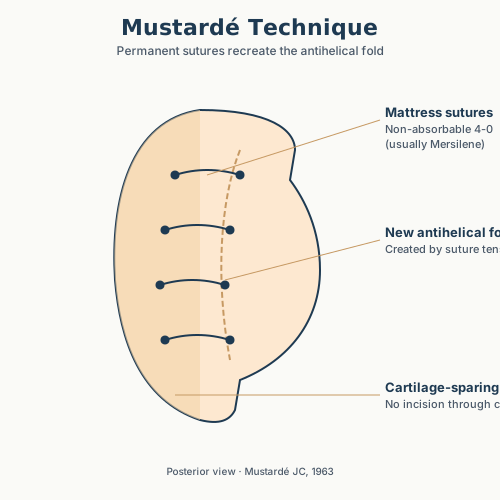
The origin of the Mustardé technique
Before 1963, otoplasty was performed almost exclusively by cutting or scoring the ear cartilage to weaken its springy memory. This worked, but it produced unpredictable contour, occasional sharp ridges, and a higher rate of complications. Jacques Mustardé, working at Canniesburn Hospital in Glasgow, proposed a radical simplification: leave the cartilage intact, and use permanent sutures alone to hold it in the new shape.
His paper in the British Journal of Plastic Surgery in 1963 became one of the most influential publications in the history of aesthetic ear surgery. Today, his name remains attached to the suture pattern he described, and the Mustardé technique forms the foundation of how virtually all surgeons perform the antihelical-fold portion of otoplasty.
What the Mustardé technique accomplishes
The Mustardé technique addresses one specific anatomical problem: an absent or shallow antihelical fold. This is the inner Y-shaped ridge of the ear, and its presence is what gives a normal ear its smooth inward curve at the top. When the antihelical fold is missing (about 70% of prominent-ear cases), the upper third of the ear flops outward.
The technique does not directly address conchal projection (the bowl-shaped depression near the ear canal). When concha is over-projected, Furnas sutures are added in combination.
Step-by-step: how Mustardé sutures are placed
Marking
Before surgery, the desired location of the new antihelical fold is marked on the front of the ear. The surgeon gently presses the ear backward to identify where the natural fold would create a smooth curve. Fine ink-dipped needles are passed through the cartilage from front to back at the planned suture locations, leaving small ink dots on the back of the cartilage.
Suture placement
Through the posterior incision, the back of the cartilage is exposed. Each Mustardé suture is a horizontal mattress: the needle passes through the cartilage at one side of the future fold, exits on the front but stays under the perichondrium, then re-enters the cartilage 6–10 mm away on the other side of the fold, exiting again at the back.
Three to four sutures are placed sequentially along the length of the antihelical fold: one for the upper third, one in the middle, one in the lower third, and sometimes a fourth for the most superior or inferior aspects.
Tying
Sutures are tied loosely first, then incrementally tightened while the surgeon views the front of the ear. The goal is the smoothest possible antihelical curve without over-correction. If a suture is too tight (creating a sharp ridge), it's loosened. If too loose (the fold is still incomplete), it's tightened.
Once the front-view is satisfactory, the surgeon makes final knots and trims the suture ends carefully so they don't poke through the skin.
Suture material selection
The choice of suture material matters. Mustardé originally used silk, but silk eventually weakens and dissolves. Today, the most common materials are:
- Mersilene (polyester) — most common worldwide. Non-absorbable, holds permanently, low extrusion rate when buried properly. Our preferred suture.
- Prolene (polypropylene) — also non-absorbable, slightly more likely to extrude through skin over years.
- PDS (polydioxanone) — slowly absorbable. Some surgeons use it to avoid permanent foreign material, but absorption can lead to higher relapse rates.
Potential issues and how we avoid them
Suture extrusion
A suture knot can sometimes work its way out through the skin behind the ear over months or years (about 2–5% of cases). When this happens, the suture is simply trimmed in clinic. The new antihelical fold is usually maintained by scar tissue that has formed by that point. To minimize extrusion, we bury knots deeply and orient them away from the skin surface.
Visible suture lines
If a suture is tied too tight or placed too superficially, it can produce a visible 'dimple' or ridge on the front of the ear. We avoid this by tightening sutures gradually while viewing from the front, and by placing the cartilage bites carefully not too close to the perichondrium on the visible side.
Partial relapse
If sutures pull through cartilage (cheese-wiring) over time, the ear can partially return toward its prominent position. This occurs in about 1–3% of cases. We minimize this by taking adequate cartilage bites and using non-absorbable suture material.
When Mustardé alone is enough vs. when more is needed
About 50% of prominent-ear patients have isolated antihelical-fold deficiency and require only Mustardé sutures. The other 50% have additional conchal projection that needs Furnas sutures in combination. A small subset of patients have unusually thick or springy cartilage that resists suture-only correction and benefit from a small amount of additional anterior cartilage scoring.
The decision is made during the in-person consultation by examining the cartilage thickness, springiness, and the specific contribution of each anatomical element to your overall ear position.