Otoplasty Recovery: Week-by-Week.
Otoplasty recovery is straightforward compared to most facial surgery. Most patients are back to office work within 7–10 days and to full sport within 4 weeks. Here's exactly what to expect, day by day.
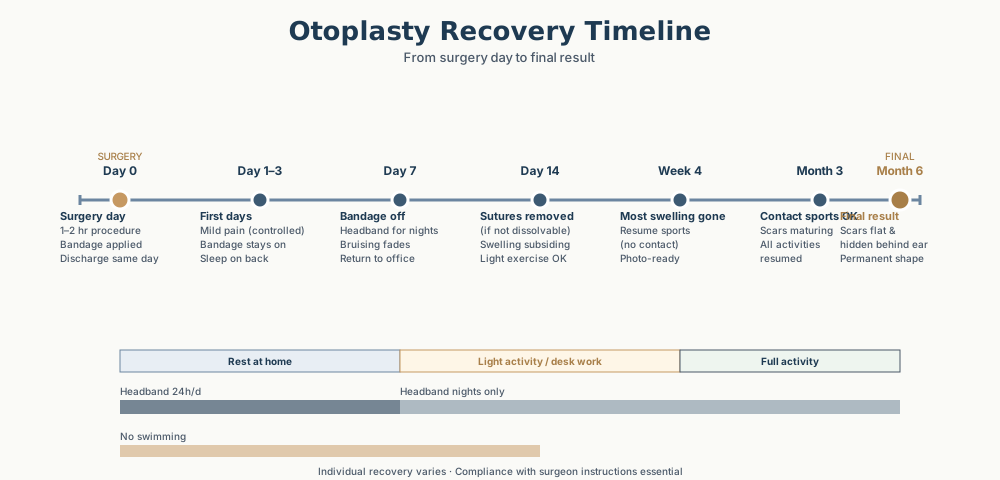
Recovery at a glance
- Pain levelMild to moderate (paracetamol-controlled)
- Bandage removalDay 5–7
- Hair washingFrom day 5–7
- Back to office workDay 7–10
- Flying homeSafe from day 7
- Light exerciseWeek 4
- Contact sportsMonth 3
- Final resultMonth 6
Day 0 — surgery day
You arrive at the hospital or surgical center 1 hour before the procedure. Pre-op preparation includes signing consent, marking the ears, and (for adults under local anesthesia) light sedation if you choose it.
The surgery itself takes 1.5 to 2 hours for both ears. You are aware throughout (for local anesthesia) but won't feel pain — just tugging and pressure. Many patients listen to music with one earbud in their nose-side ear.
After surgery, a soft head-wrap bandage is applied. You stay in recovery for about 1 hour, then go home or to the hotel by early afternoon. You'll feel groggy if you had sedation; tomorrow you'll feel normal.
- Two pillows (sleep elevated)
- Loose-fitting button-down or zip-front shirts (don't pull over the head)
- Soft food (you may chew normally but jaw movement near the ear can feel odd)
- Paracetamol or paracetamol+codeine (we prescribe)
- An audiobook or movies (you'll be resting)
Day 1–3 — first days
You'll feel some discomfort, especially when changing position or accidentally bumping the bandage. The first night may be the worst for sleeping comfort — sleep flat on your back with two pillows under your head, not on your side.
Mild pain medication is sufficient for most patients. The bandage stays on, dry and undisturbed. Don't try to peek underneath — it's snug for a reason.
By day 3, you'll feel almost normal. You can walk around the hotel and the immediate neighborhood. Avoid bending over, lifting anything heavy, or any activity that raises blood pressure significantly.
Day 5–7 — bandage removal
You'll come to the clinic for bandage removal. This is the first time you see your new ears. There will be some swelling and possibly mild bruising at the bandage edges. The basic new shape is visible — what surprises most patients is how much better the ears already look despite the swelling.
After removal:
- You can gently shower and wash your hair (avoid rubbing the ears; pat them dry)
- You'll switch to a soft tennis-style headband worn 24 hours a day for one more week
- Light walking and normal movement are fine
- You can usually fly home from day 7 onwards (we discuss the exact day with you)
Day 7–14 — return home, return to work
By day 7–10, most patients fly home. Office work and light activity are fine. Continue the headband at night.
You may have mild numbness or tingling around the ears — this is normal and will resolve over weeks to months. Some patients also feel intermittent itching as nerves regenerate; this is also normal.
Week 4 — first photo-ready milestone
By the end of week 4, most of the visible swelling has resolved. The ears look about 90% of their final shape. Most patients are happy to be photographed by week 4.
Activity wise:
- Resume cardio (running, cycling, swimming with care)
- Resume weight training (no head impact)
- Continue the headband at night for 2 more weeks
Month 3 — contact sports cleared
From month 3, you can return to all activities including contact sports — boxing, martial arts, rugby, wrestling, headers in football. The cartilage is fully secure by this point.
Scars are still pink and slightly raised, which is normal. They will continue to fade over the next 3 months.
Month 6 — final result
By six months, scars have fully flattened and faded. Swelling is fully resolved. This is the appearance you will have for life. Patients who had surgery as adults often describe a delayed realization — "I forgot I had surgery" — when they look in the mirror normally without thinking about it.
What's normal vs. what to call about
| Symptom | Normal? | What to do |
|---|---|---|
| Mild pain controllable with paracetamol | Normal | Continue as prescribed |
| Numbness or tingling around the ears | Normal (weeks to months) | No action needed, will resolve |
| Itching | Normal as nerves regenerate | Don't scratch; topical antihistamine if severe |
| Bruising spreading down the neck | Normal in the first week | Resolves over 2 weeks |
| Severe pain not controlled by medication | Not normal | WhatsApp us immediately — could indicate hematoma |
| Rapidly increasing swelling on one side | Not normal | WhatsApp us immediately |
| Fever above 38°C / 100.4°F after day 2 | Not normal | WhatsApp us — could indicate infection |
| Stitch poking through the skin behind the ear | Occasional | Don't pull it; we'll remove if needed |
| One ear visibly different from the other after week 4 | Possible | Wait for swelling to fully resolve; report at month 3 follow-up |
Practical tips that make recovery easier
- Sleep position matters. Use two pillows and sleep on your back for the first 2 weeks. Train yourself before surgery if you're normally a side sleeper.
- Stock the hotel before surgery. Food, water, painkillers, button-front shirts, audiobooks. You won't want to go shopping in the first 3 days.
- Don't pull clothes over your head. Use button-down or zip-front clothing for the first 2 weeks.
- Avoid alcohol for at least 1 week post-op — it thins the blood and increases bruising.
- Stay hydrated. Healing requires good hydration, especially in Istanbul's drier summer months.
- The headband matters. Patients who skip the headband at night have higher partial relapse rates. Wear it.