Otoplasty: A Complete Guide to Prominent Ear Surgery
Otoplasty is one of the most consistently rewarding procedures in plastic surgery, with patient satisfaction rates above 95% in published series. This guide explains what otoplasty is, how it's performed, what to expect during recovery, and the questions every patient should ask before surgery.
Otoplasty at a glance
- Operative time1.5–2 hours (both ears)
- AnesthesiaLocal + sedation (adults); general (children)
- Hospital stayDay surgery — go home same day
- Bandage removalDay 5–7
- Back to office workDay 7–10
- Resume sports4 weeks (non-contact); 3 months (contact)
- Final result6 months after surgery
- ScarsHidden behind the ear, invisible from front
- ICD-9 code18.5 (Plastic operations on auricle)
- Long-term success97% — minor revision rate 1–3%
What is otoplasty, exactly?
Otoplasty (from the Greek ous, ear, and plastikos, to shape) is the surgical correction of the external ear. The term covers several distinct operations grouped under one name:
- Setback otoplasty — the most common form, treating prominent ears by reducing their angle to the head
- Constructive otoplasty — treating congenital deformities like Stahl's ear, cup ear, or cryptotia
- Reduction otoplasty — treating macrotia (oversized ears)
- Revision otoplasty — correcting unsatisfactory results from previous surgery
- Earlobe surgery — repair of split or stretched earlobes (technically a related but separate procedure)
When patients use the word "otoplasty," they almost always mean setback otoplasty for prominent ears. That's the focus of this guide; we cover the others in dedicated pages.
Understanding the anatomy
Before the technique makes sense, you need to know the anatomy.
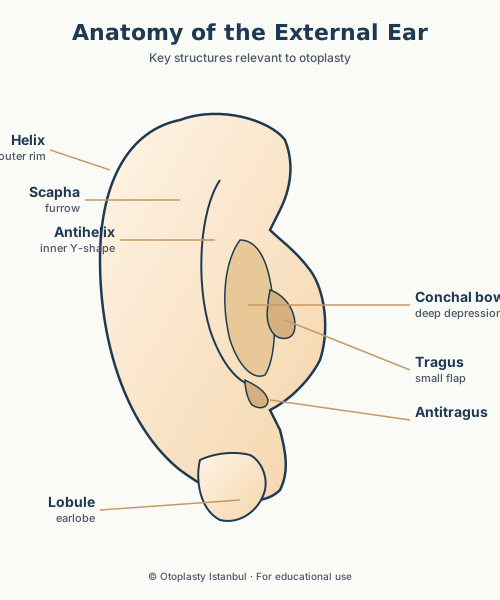
The external ear has several named structures that matter for otoplasty:
- Helix — the outer rim. Its shape is rarely altered.
- Antihelix — the Y-shaped ridge inside the helix. In prominent ears, this ridge is often shallow or absent, which lets the upper ear fold outward.
- Conchal bowl — the deep depression next to the ear canal. When over-projected (too deep / too lateral), it pushes the entire ear away from the head.
- Tragus and antitragus — small flaps near the ear canal, rarely altered in otoplasty.
- Lobule (earlobe) — the soft lower portion. Can also be prominent; if so, requires its own technique.
The two surgical targets
A "prominent ear" is almost always one of three combinations:
- Antihelical fold problem (about 50% of cases): The antihelix is underdeveloped, so the upper third of the ear flops forward. The conchal bowl is normal.
- Conchal projection problem (about 20% of cases): The antihelix is fine, but the conchal bowl is enlarged or over-projected, pushing the entire ear outward.
- Both (about 30% of cases): Combined deformity requiring both corrections.
This is why a "one-size-fits-all" approach to otoplasty produces unnatural results. The first job of the surgeon is diagnosis: which features of your ear need correction, and which should be left alone.
How otoplasty is performed
The cartilage-sparing approach
The dominant modern approach is cartilage-sparing otoplasty, also called "suture otoplasty." We combine two named techniques:
Mustardé sutures (1963)
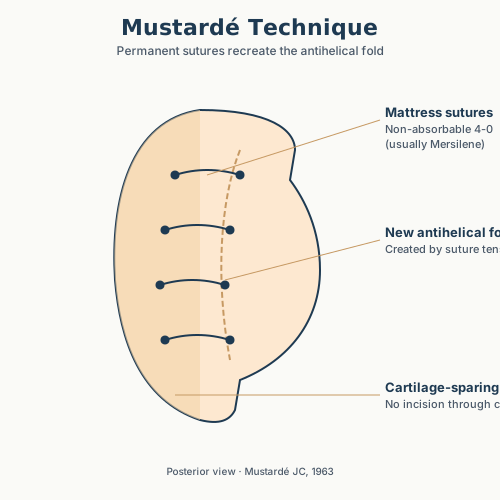
Three to four permanent horizontal mattress sutures placed across the future antihelical fold. As the sutures are tightened, the cartilage bends inward, creating the natural Y-ridge.
Furnas sutures (1968)
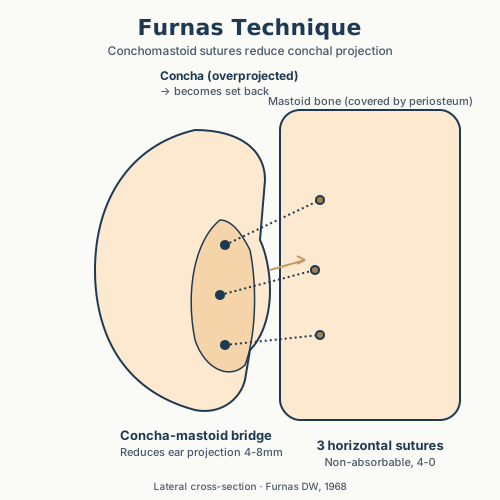
Three permanent sutures from the back of the conchal cartilage to the periosteum overlying the mastoid bone. These pull the conchal bowl backward and reduce ear projection.
For your specific anatomy, we use one technique, the other, or both. The cartilage itself is left intact — no cuts, scoring, or rasping. This preserves the natural blood supply and the smooth surface of the front of the ear.
Cartilage-scoring (when indicated)
In patients with thick, springy cartilage that resists suture-only bending (more common in some adults and certain ethnic anatomies), gentle scoring on the anterior cartilage surface can be added. This weakens the cartilage's elastic memory and allows the antihelix to fold more readily. Modern scoring is precise — done with a small rasp through the same posterior approach — and produces excellent results when needed.
The incision
All work is performed through a single incision placed behind the ear, in the natural crease where the ear meets the scalp. The incision is closed with absorbable sutures and heals as a thin scar that is invisible from the front and difficult to see even from behind once mature.
Bandaging
After surgery, a soft head-wrap bandage is applied for 5–7 days. This compresses the ear against the head while the sutures secure their hold on the cartilage. After the bandage comes off, a tennis-style headband is worn at night for an additional 4–6 weeks to protect the ears from accidental folding during sleep.
Anesthesia options
| Type | Used for | Pros | Cons |
|---|---|---|---|
| Local + light sedation | Most adults | Faster recovery, no fasting required for long periods, lower cost, no nausea | Patient is awake; requires patient cooperation |
| General anesthesia | Children, anxious adults | Patient is fully asleep, no sensation | Slightly longer recovery, requires fasting |
| Deep sedation | Adults preferring not to be awake | Middle ground — comfortable, but recovery is faster than full general | Slightly more expensive than local-only |
Recovery: what actually happens
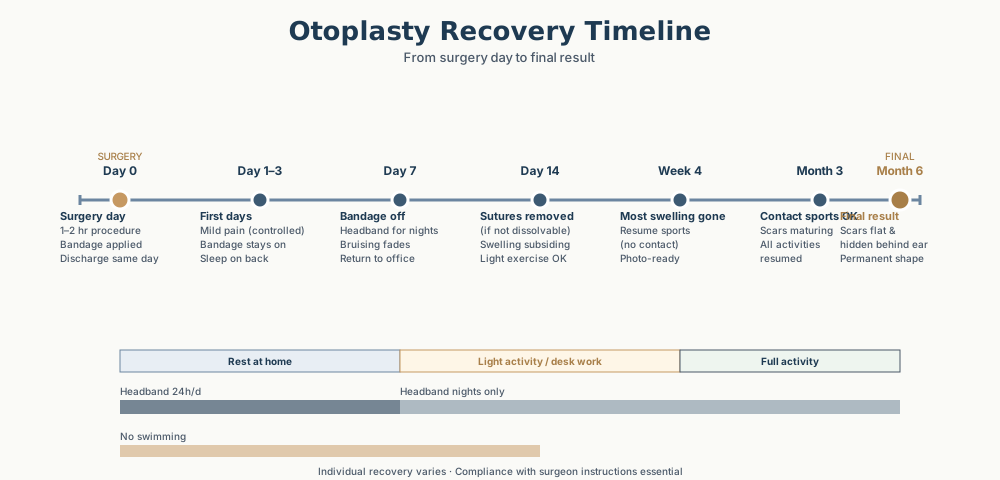
Surgery day
1.5–2 hour procedure. You arrive in the morning, surgery is mid-morning, and you go home or back to the hotel by early afternoon. A soft bandage covers both ears. Mild discomfort is controlled with oral painkillers.
First days at the hotel
Rest in elevated position. Sleep on the back, head elevated on two pillows. Pain typically decreases by day 2. Bandage stays dry and undisturbed.
Bandage removal
We unwrap the bandage in clinic. The ears look significantly less swollen than expected. Light bruising may be present. You switch to a soft headband worn 24 hours a day for one more week, then nights only.
Fly home
Most international patients fly home around day 7–10. You can return to office work and light activity. Continue the headband at night.
Most swelling resolved
The ears begin to look close to their final shape. Light exercise (walking, cycling) is fine. No contact sports yet.
Contact sports resume
Boxing, martial arts, rugby, wrestling — all sports involving direct ear contact — can resume after 3 months. The scar is still maturing but the cartilage is secure.
Final result
Scars have flattened and faded. Swelling is fully resolved. This is the appearance you'll have for life.
Risks and how we minimize them
Otoplasty is a generally safe procedure, but it is surgery, and surgery carries risks. We discuss every risk in detail at consultation; the most important are summarized here.
| Risk | Approx. rate | How we minimize |
|---|---|---|
| Hematoma (collection of blood) | 1–2% | Careful hemostasis, post-op bandage compression, patient avoids blood thinners pre-op |
| Infection | under 1% | Prophylactic antibiotics, sterile technique, clear post-op wound care |
| Suture extrusion | 2–5% | Deep placement, knot orientation, use of appropriate suture materials |
| Asymmetry requiring touch-up | 3–5% | Symmetric markings before surgery, intraoperative comparison, conservative correction |
| Partial relapse | 1–3% | Adequate suture placement, patient compliance with headband |
| Hypertrophic / keloid scarring | under 2% | Patient screening, scar massage protocol, early intervention if needed |
| Numbness (usually temporary) | Common, weeks to months | Resolves spontaneously in most patients |
Over-correction — the ears pulled too far back, called "pinned" or "telephone ear" — is a well-known complication of older, more aggressive techniques. Modern cartilage-sparing methods virtually eliminate this risk because the corrections are measured and reversible during surgery. We aim for a 17–21° auriculocephalic angle — natural, not pinned.
Who is a candidate?
You are likely a good candidate for otoplasty if:
- You are bothered by the appearance of your ears (the most important criterion — otoplasty is elective)
- You are at least 5 years old (when the ear is close to full size)
- You are in good general health, without bleeding disorders or active skin infections at the surgical site
- You don't smoke, or can stop for 2 weeks before and after surgery
- You have realistic expectations — natural ears, not "perfect" ears
Patients are not good candidates if they:
- Are being pressured by someone else to have surgery
- Have unrealistic expectations of perfection
- Cannot stop blood-thinning medications
- Have a history of severe keloid scarring
Otoplasty in Istanbul: what makes it different
Istanbul has become a top destination for international plastic surgery for genuine reasons — cost, quality of trained surgeons, ease of travel, and excellent private hospital infrastructure. For otoplasty specifically:
- Cost is 40–60% lower than equivalent operations in the UK, US, Germany, or Australia, without compromising quality when you choose the right surgeon
- Surgeons can be highly credentialed — Turkish plastic surgeons frequently hold European (FEBOPRAS), American (FACS), and ISAPS memberships, with active research records
- Hospitals are modern and accredited — major private hospital groups in Istanbul are JCI-accredited and operate to the same standards as Western Europe
- Logistics are easy — Istanbul is 3 hours from London, 2.5 hours from most of Western Europe, direct flights from the Middle East and Russia
- USHAŞ certification — the Turkish Ministry of Health's international health tourism certification ensures legal protection and standardized care for foreign patients
For more on this, see our pages on why Istanbul, the Nişantaşı clinic, and the international patient guide.