Cartilage-Sparing Otoplasty
Key facts
- Cartilage traumaNone
- Suture materialNon-absorbable 4-0 (Mersilene)
- ReversibilityYes — sutures can be removed
- Operative time1.5–2 hours bilateral
- AnesthesiaLocal + sedation or general
- Risk of relapse1–3%
- Risk of over-correctionVery low
- Patient candidacyMost adults and children age 5+
What is cartilage-sparing otoplasty?
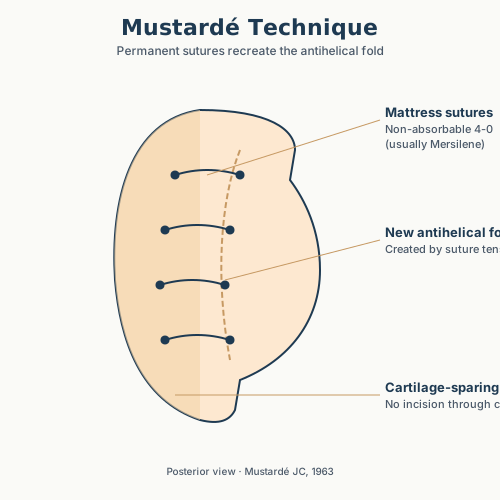
Cartilage-sparing otoplasty is the dominant modern technique for correcting prominent ears. Instead of cutting through cartilage to weaken its springy memory (as older techniques did), the surgeon places permanent sutures on the back of the cartilage that gently bend it into the desired shape. The cartilage itself remains intact and continuous.
The approach was pioneered by Jacques Mustardé (1963) for the antihelical fold and David Furnas (1968) for conchal setback. Today, virtually all leading otoplasty surgeons worldwide use some combination of these two techniques as their first-choice approach.
Why surgeons prefer cartilage-sparing
Compared to older cartilage-scoring or cartilage-cutting techniques, the cartilage-sparing approach offers several practical advantages:
- No sharp ridges. Scored cartilage can produce visible ridges or distortions of the antihelical contour over time. Sutures produce smooth, natural curves.
- Reversibility. If a suture is too tight or in the wrong position, it can be removed or replaced. Cartilage cuts cannot be undone.
- Lower complication rate. Without cartilage exposure, the risk of infection, cartilage necrosis, and hematoma is reduced.
- Faster recovery. Less surgical trauma means less swelling and discomfort.
- Better long-term contour. The natural cartilage memory is preserved; the sutures simply override the prominent posture.
How the operation is performed
Step 1: Marking
Before surgery begins, the desired location of the new antihelical fold is marked on the front of the ear using a fine pen and a small needle (the needle is dipped in marking dye and inserted from front to back, marking through both surfaces). This ensures the surgeon knows exactly where to place the sutures from the rear.
Step 2: Posterior incision
A single curved incision is made behind the ear, in the natural skin crease where the auricle meets the scalp. A thin elliptical strip of skin may be removed in some cases to reduce post-op redundancy.
Step 3: Cartilage exposure
The skin is elevated off the back of the cartilage in a careful subperichondrial plane. The entire posterior surface of the ear cartilage is now accessible.
Step 4: Mustardé sutures (for antihelix)
Three to four horizontal mattress sutures of non-absorbable material (typically 4-0 Mersilene) are placed across the future antihelical fold, taking 6–10 mm bites of cartilage on each side. As each suture is tied, the cartilage bends inward, creating a smooth new antihelical fold. Suture tension is adjusted iteratively, and the result is observed from the front before final knotting.
Step 5: Furnas sutures (for concha, when needed)
If conchal projection contributes to the prominence, three additional sutures are placed from the back of the conchal cartilage to the periosteum overlying the mastoid bone. These pull the conchal bowl backward toward the skull. Care is taken not to narrow the external ear canal.
Step 6: Symmetry check and closure
Both ears are compared by viewing from the front, sides, and above. Sutures are adjusted as needed to ensure symmetry within 3 mm at any level. The skin incision is then closed with absorbable sutures (typically 5-0 Monocryl), and a soft head-wrap bandage is applied.
Who is a good candidate?
Cartilage-sparing otoplasty is the first-choice technique for the majority of prominent ear cases. It works best when:
- The cartilage is reasonably flexible (most patients under age 40)
- The primary problem is absent antihelical fold, conchal projection, or both
- The cartilage is not unusually thick
- Both ears need symmetric correction
In patients with very thick, springy cartilage (more common in some adults), a small amount of anterior scoring can be added to weaken the cartilage's memory and allow the sutures to hold the new shape more reliably. This is a 'cartilage-sparing plus' approach.
Comparison with older techniques
| Aspect | Cartilage-sparing (Mustardé/Furnas) | Cartilage-scoring (Stenström) | Cartilage-cutting (Converse) |
|---|---|---|---|
| Cartilage trauma | None | Anterior surface scored | Cartilage incised or excised |
| Reversibility | Yes | No | No |
| Risk of sharp ridges | Very low | Moderate | Higher |
| Risk of necrosis | Very low | Low | Higher |
| Suitable for thick cartilage | Sometimes (with scoring add-on) | Yes | Yes |
| Recovery speed | Faster | Moderate | Slower |
| Current usage | First choice today | Selected cases | Historical / specific indications |
Results and long-term outcomes
Long-term outcomes of cartilage-sparing otoplasty are excellent. Published series report patient satisfaction rates above 95% at 5+ year follow-up. Partial relapse — where one ear or part of an ear gradually returns toward its prominent position — occurs in approximately 1–3% of cases, usually within the first 12 months. Minor revision is straightforward when needed.
The aesthetic result tends to age well because the cartilage itself is undamaged. Patients who had cartilage-sparing otoplasty 20–30 years ago typically still have natural-appearing, well-positioned ears.
Doç. Dr. Ayhan Işık Erdal uses cartilage-sparing otoplasty as the first-choice approach for the majority of cases. Cartilage-scoring is added only when specific cartilage characteristics warrant it. Patients are individually evaluated; no 'one-size-fits-all' protocol.